Buying Vacant Land on Kauaʻi? Check This First
Short answer: Buying vacant land on Kauaʻi isn't as simple as buying a blank canvas. Before you close, you need to verify legal access, water availability, an approved wastewater option (cesspools have been illegal for new construction since 2016), the actual buildable area after setbacks, any CPR or ownership restrictions, and whether the parcel sits in a flood zone or requires shoreline permitting. Skip any one of these and "buildable land" can quietly become land you can't actually build on, or can't afford to.
5 minute read: Below I'll walk through every major due diligence category for raw land on Kauaʻi, the mistakes I see most often, and the questions I always tell clients to get answered in writing before removing contingencies.
Why This Matters
Vacant land carries risks a finished home simply doesn't, because so much is still unknown or unconfirmed:
- A parcel can be legally unbuildable, or buildable only at significant extra cost, in ways that aren't obvious from photos or a listing description
- Infrastructure gaps, no nearby water main, no approved wastewater option, can turn a "good deal" into a very expensive project
- Financing raw land is harder than financing a home, and lenders often want answers to exactly these questions before approving a loan
- Resale value depends heavily on whether the next buyer can actually build what they're picturing
In Plain English
Buying vacant land is less like buying a finished painting and more like buying a blank canvas that comes with its own rulebook, how big you're allowed to paint, what kind of paint you're allowed to use, and whether there's even a wall to hang it on. The land might look wide open, but the legal and infrastructure reality underneath it is often much narrower than it appears.
The Details
Zoning and Buildable Density
What you're allowed to build depends on the parcel's zoning district, and the density formula that comes with it. This is especially important on agricultural land, where Kauaʻi's density rules tie the number of allowed dwelling units to acreage, not simply to how the land feels or how big it looks on a map.
Legal Access
A parcel needs documented, legal access to be genuinely useful, not just physical access you happened to walk in on. Landlocked parcels, or parcels relying on an unrecorded or informal access route, are a real and recurring issue on Kauaʻi, particularly with older or subdivided agricultural land. This should be confirmed through a title search, not assumed from a site visit.
Water Availability
Kauaʻi's building permit process requires clearance from the County Department of Water for a water meter before construction can move forward. Not every parcel sits near existing water infrastructure. If county water isn't readily available, extending a water main at the owner's expense can be substantial.
If county water isn't a realistic option, a private well is the alternative, but it's not a casual undertaking. Drilling a well in Hawaii requires a Well Construction Permit from the state Commission on Water Resource Management (CWRM) under HRS Section 174C-84, and no drilling work can begin before that permit is issued. Costs vary significantly based on depth, geology, and the specific site, so get an actual quote from a licensed well driller for your parcel rather than relying on a general statewide estimate.
Wastewater System
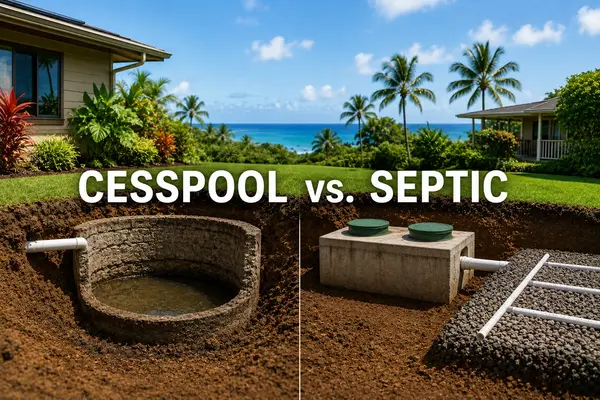
Hawaii banned the construction of new cesspools statewide in 2016 under Act 120, and a 2017 follow-up law, Act 125, requires all existing cesspools to be upgraded, converted, or closed by January 1, 2050. In practical terms, this means vacant land buyers cannot install a cesspool for new construction. You'll need an approved individual wastewater system (a septic or aerobic treatment system regulated by the Hawaii Department of Health Wastewater Branch) or a connection to an existing sewer system where one is available.
| Wastewater Option | Status for New Construction |
|---|---|
| Cesspool | Not allowed, banned statewide since 2016 |
| Septic / individual wastewater system | Allowed, requires Department of Health approval |
| Connection to sewer system | Allowed where a sewer system is actually available |
Setbacks and Buildable Envelope
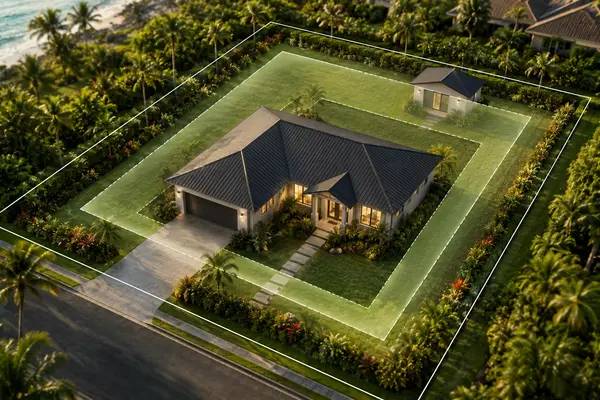
The total acreage of a parcel and the actual buildable area within it are two different numbers. Standard setback requirements shrink the usable footprint from every property line, and coastal parcels face a separate, much stricter shoreline setback system, generally running 60 to 100 feet, though the specific number depends on lot depth and whether the parcel is covered by Kauaʻi's Coastal Erosion Study, and the underlying erosion-rate formula can push it higher still for larger coastal lots. Confirm the real buildable envelope before assuming a lot can fit what you're picturing.
CPR and Other Ownership Restrictions
Some vacant parcels on Kauaʻi are part of a Condominium Property Regime, meaning the land is legally divided into ownership units on a shared underlying parcel. If that's the case, shared driveways, utility easements, and dwelling unit entitlements already allocated among the existing units can all affect what you're actually able to build on your specific portion.
Flood Zones and Special Management Area (SMA)
FEMA flood zone designations can affect insurance requirements and construction standards for a given parcel. Separately, land within Kauaʻi's Special Management Area, generally along the coast, requires its own SMA permitting process on top of standard building permits, which can add real time and cost to a project. Both should be checked early, not discovered mid-permit.
Title System
Every parcel on Kauaʻi is recorded under either Land Court or the Regular System, and this affects how title is verified and insured. It's a standard part of a title search for raw land, just as it is for any other property, and worth understanding before you're deep into escrow.
Before You Buy Vacant Land on Kauaʻi
- Confirm the zoning district and actual allowed dwelling unit density for the specific parcel
- Verify legal, recorded access through a title search, not just a site visit
- Get written confirmation of water availability from the Department of Water, or budget for a permitted well
- Confirm an approved wastewater option exists (septic or sewer, never a new cesspool)
- Calculate the real buildable envelope after standard and, if applicable, shoreline setbacks
- Check whether the parcel is part of a CPR and what shared obligations come with it
- Check FEMA flood zone status and whether the parcel falls within the Special Management Area
- Confirm which title system applies and review the preliminary title report in full
Common Misconceptions
What I Tell My Clients
With vacant land, I never let a client assume infrastructure is there just because the lot looks developed-adjacent. I have them get water availability and wastewater options confirmed in writing before we remove contingencies, not after. I also build in a real contingency budget for the unknowns, well drilling, water main extension, or septic system design, since those numbers can swing a project's economics significantly. Raw land can be a great opportunity on Kauaʻi, but it rewards patience during due diligence far more than it punishes it.
Frequently Asked Questions
No. New cesspool construction has been illegal statewide since 2016. You'll need an approved septic system or a connection to an existing sewer system instead.
Contact the County of Kauaʻi Department of Water directly to confirm availability before assuming it. Water meter clearance is a required part of the building permit process, and not every parcel sits near existing infrastructure.
You'll need a Well Construction Permit from the state Commission on Water Resource Management before any drilling can begin. Costs vary significantly by depth and site conditions, so get a specific quote from a licensed well driller rather than assuming a general statewide figure applies to your parcel.
Without documented, recorded access, a parcel can be effectively landlocked, which significantly limits its usability and value. This should be confirmed through a title search before purchase, not assumed from a site visit.
Often yes. Land within Kauaʻi's Special Management Area typically requires its own SMA permit in addition to standard building permits, and coastal parcels are also subject to a separate, stricter shoreline setback system.
Sources
Hawaii Act 120 (2016), statewide ban on new cesspool construction; Hawaii Act 125 (2017), requiring all cesspools to be upgraded, converted, or closed by January 1, 2050; Hawaii Administrative Rules Title 11, Chapter 62. See the Hawaii Department of Health Wastewater Branch, Cesspools in Hawaiʻi.
County of Kauaʻi Department of Water, Building Permit Process
Hawaii Revised Statutes Section 174C-84; Hawaii Administrative Rules Chapter 13-168, Water Use, Wells, and Stream Diversion Works. See the State of Hawaii Commission on Water Resource Management.
Kauaʻi County Code, Comprehensive Zoning Ordinance, Article 27: Shoreline Setback and Coastal Protection, Sections 8-27.3 and 8-27.4
This article is intended for educational purposes only and does not constitute legal, engineering, or financial advice. Zoning, access, infrastructure availability, and permitting requirements are highly specific to each parcel and subject to change. Buyers should conduct full due diligence with the County of Kauaʻi Planning Department, Department of Water, Department of Health, a licensed surveyor, and a real estate attorney before purchasing vacant land.
Categories
Recent Posts