
Understanding Property Setbacks
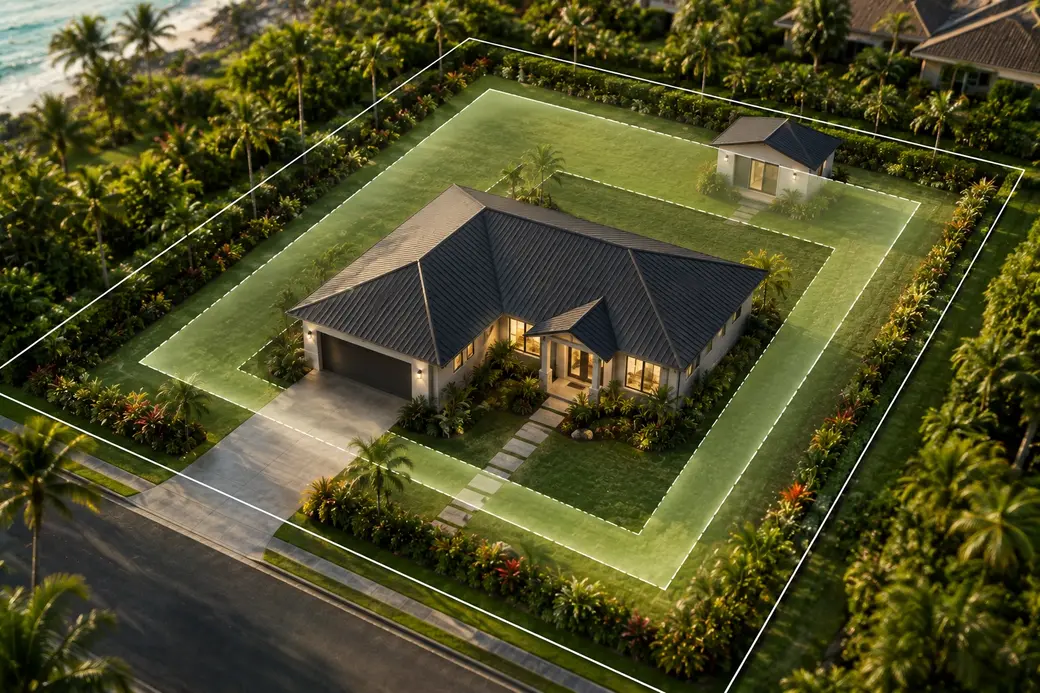
Short answer: Kauaʻi's standard setback rules require most buildings to sit at least 10 feet back from the front property line, and at least 5 feet from the side and rear lines, or half the building's height, whichever is greater. A common assumption trips people up here: agricultural and Open zoned parcels generally follow these same base numbers as residential parcels under county code, they aren't a separate, looser standard just because the lot is bigger. Coastal properties are a different story entirely: within 500 feet of the shoreline, a completely separate setback system applies, and it can require 60 to 100 feet or more depending on lot depth and erosion data.
5 minute read: Below I'll walk through the actual setback figures, where the exceptions are, and why the size of your lot doesn't necessarily mean more buildable room than you'd expect.
Why This Matters
Setbacks quietly determine how much of your lot is actually usable, which affects:
- Where you can realistically place an ADU, pool, deck, or addition
- Whether a narrow or oddly shaped lot has enough buildable area for what you're picturing
- Corner lots specifically, which can require more than one front setback
- Privacy and view corridors between you and your neighbors
- Costly rework or removal if a structure gets built without accounting for them correctly
In Plain English
Think of setbacks like an invisible frame drawn just inside your property lines. No permanent structure can cross into that frame, no matter how large your lot looks on paper. A bigger parcel can feel like it has more room to work with, but that frame stays roughly the same width regardless of whether your lot is a quarter acre or twenty acres.
The Details
The Base Setback Standards
Kauaʻi County's Comprehensive Zoning Ordinance sets these standard minimum setbacks for residential-type development:
In practice, the side and rear numbers grow as a building gets taller. A single-story home might only need the flat 5 foot minimum, while a taller structure could require significantly more clearance, since the setback scales with half the wall height nearest that property line.
Corner Lots
A property bounded by more than one street generally requires more than one front setback, one for each street frontage. The owner may choose a single front yard for the purpose of establishing where the rear yard falls, but every street-facing side still carries front setback obligations, not the more relaxed side or rear standard.
Distance Between Structures
Separate structures on the same lot, a main house and a detached ADU, for example, generally need at least 10 feet of clearance between them, independent of the setbacks measured from the property lines themselves.
Exceptions and Projections
A few limited exceptions exist:
- Roof eaves, overhangs, and similar appurtenances may project into a setback, but only up to half the setback distance or 4 feet, whichever is less
- Small accessory buildings, no taller than 7 feet and no larger than 400 square feet, may be built without meeting setback requirements, provided they don't exceed 20% of the rear property line's length
- Balconies, decks, carports, and other occupied exterior spaces above the ground floor generally cannot penetrate the setback area at all
Shoreline and Coastal Setbacks Are a Completely Different System
Everything above applies to standard inland development. If a property sits within 500 feet of the shoreline, an entirely separate and much stricter set of rules takes over under Kauaʻi's Shoreline Setback and Coastal Protection ordinance, and the standard 10 foot front or 5 foot side and rear numbers simply don't apply.
| Average Lot Depth | Shoreline Setback Line |
|---|---|
| Less than 140 feet | 40 feet + (70 × annual erosion rate) + 20 foot mandatory buffer |
| 140 to 220 feet | Greater of the formula above, or (lot depth − 100) ÷ 2 + 40 feet |
| Greater than 220 feet | Greater of the formula above, or a flat 100 feet |
| Lots not in the Coastal Erosion Study | (Lot depth − 100) ÷ 2 + 40 feet, never less than 60 feet, capped at 100 feet |
In every case, no shoreline setback line on Kauaʻi can be less than 60 feet, except through an approved variance. This distance is measured from the certified shoreline, a legal determination made by the State, not simply the visible waterline on a given day, and it requires a survey to establish accurately.
Because this determination depends on erosion rate data, average lot depth, and a certified shoreline survey specific to that parcel, it isn't something that can be estimated from a listing or a tax map. Any coastal property, or one that might fall within 500 feet of the shoreline, needs its own shoreline setback determination from the Planning Department before assuming what's actually buildable. This article was amended by County Ordinance No. 1187 in March 2026, so confirm current figures directly with the Planning Department before relying on the numbers above for a specific transaction.
Common Misconceptions
What I Tell My Clients
Before a client falls in love with a vacant lot or a renovation plan, I have them confirm the actual buildable envelope with the County Planning Department rather than assuming based on total parcel size. This matters most on narrow lots, corner lots, and any project involving significant height, since that's exactly where the setback math starts eating into the space people assumed they had. It's a lot easier to find this out before an offer than after a survey comes back mid-escrow.
Frequently Asked Questions
Generally 10 feet from the front property line, and 5 feet from the side and rear lines, or half the building's height, whichever is greater. Specific zoning districts and site conditions can adjust these numbers.
Generally no. County code applies the same base setback standards used in Residential Districts to both Agriculture and Open Districts by default, aside from a higher maximum building height allowance for non-residential agricultural structures.
Only if it's genuinely small, no taller than 7 feet and under 400 square feet. Anything larger, including most sheds, garages, and ADUs, needs to meet the standard setback requirements.
A corner lot generally requires more than one front setback, since each street-facing side of the property carries front setback obligations rather than the more relaxed side setback standard.
Yes. The county can require greater setbacks as a condition of a Zoning Permit based on site-specific factors like topography, drainage, sun exposure, or privacy, so the standard numbers should be treated as a floor, not a final answer.
No. Properties within 500 feet of the shoreline are governed by a separate Shoreline Setback and Coastal Protection ordinance, which can require setbacks of 60 to 100 feet or more based on lot depth and erosion rate data, and may also require a separate Special Management Area permit.
Related Articles
Sources
Kauaʻi County Code, Comprehensive Zoning Ordinance, Chapter 8, Article 4: Residential Districts (R) (setback standards, §8-4.3(b) and (c)), Article 8: Agriculture Districts (A) (confirming Agriculture District development standards mirror the Residential District), Article on Open Districts (O) (confirming Open District development standards default to the Residential District as well), and Article 27: Shoreline Setback and Coastal Protection (shoreline setback formula and minimums), amended by County Ordinance No. 1187 (March 2026)
County of Kauaʻi Planning Department, Special Management Area & Shoreline Setback, hosting the official Special Management Area Rules and Regulations (approved April 14, 2026), separate from the shoreline setback ordinance above
This article is intended for educational purposes only and does not constitute legal or zoning advice. Setback requirements can vary based on specific zoning district, site conditions, and permit history for an individual parcel. Buyers and owners should confirm current requirements directly with the County of Kauaʻi Planning Department before making building or purchase decisions.
Categories
Recent Posts