Cesspool vs. Septic on Kauaʻi
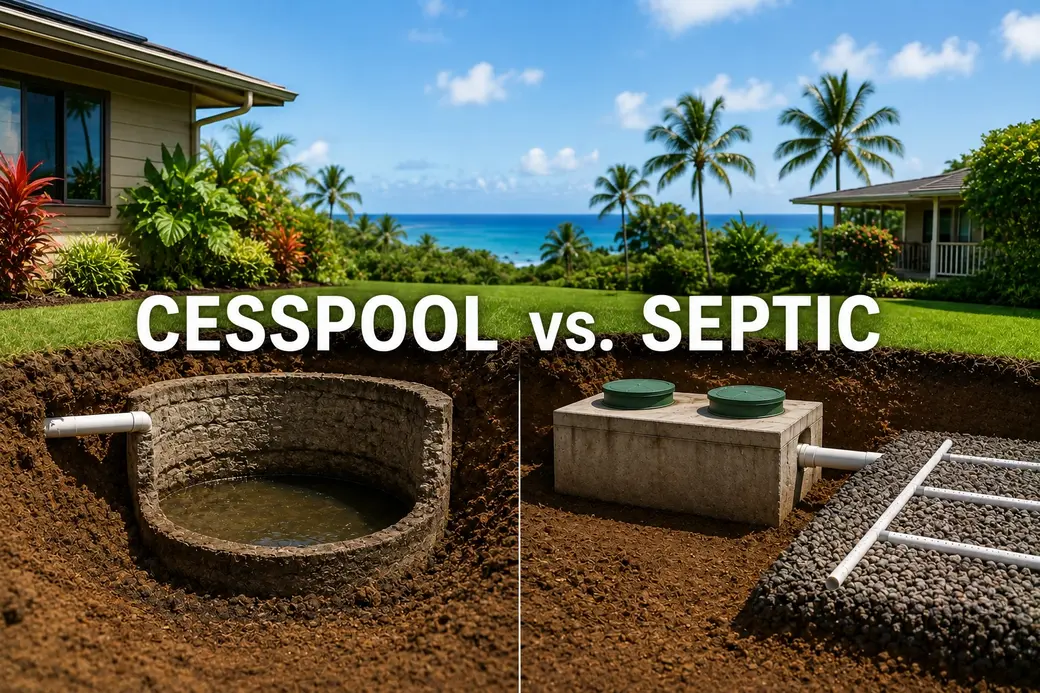
Short answer: A cesspool is essentially a hole in the ground that releases raw sewage directly into it, untreated. A septic system treats wastewater before releasing it. Hawaii banned new cesspool construction in 2016 and requires every existing cesspool statewide to be converted, upgraded, or closed by 2050, but three Kauaʻi communities, Kapaʻa/Wailua, Poʻipū/Koloa, and Hanalei, are on the state's accelerated priority list, meaning some homeowners there may need to act well before that deadline. Statewide sources cite a $25,000 to $50,000 range, but on the ground on Kauaʻi, actual conversions rarely come in near that lower figure, and often run higher, especially in rocky areas like Poʻipū and Koloa.
5 minute read: Below I'll walk through the real difference between the two systems, exactly which parts of Kauaʻi are on the state's priority list, what can force a conversion sooner than 2050, and the financial help that's now actually available.
Why This Matters
Whether a Kauaʻi property has a cesspool or a septic system affects far more than a line item on an inspection report:
- It's a required part of the seller's disclosure statement, and it factors into how buyers and sellers negotiate price
- Properties in Kauaʻi's three designated priority areas may face a compressed conversion timeline, not the full runway to 2050
- Adding an ADU or making major renovations can trigger an immediate upgrade requirement, regardless of the 2050 deadline
- Financing and insurance can be affected, some lenders want proof of a compliant system before approving a loan
- New state and county funding programs can meaningfully offset what used to be an entirely out-of-pocket cost
In Plain English
Think of a cesspool as a bucket with holes in the bottom, buried straight in the ground. Whatever goes in eventually seeps out into the surrounding earth, no filtering, no treatment. A septic system is that same idea, but now there's a filter and a proper drainage field built underneath it, treating the wastewater before it's released. Hawaii has decided every home eventually needs the filtered version, not the leaky one, and for a few specific Kauaʻi neighborhoods, "eventually" is closer than 2050.
The Details
Hawaii's Statewide Timeline
Hawaii banned the construction of new cesspools statewide in 2016 under Act 120. In 2017, Act 125 went further, requiring every existing cesspool in the state to be upgraded, converted to septic, or connected to sewer by January 1, 2050. Hawaii is the only state that still has large numbers of residential cesspools in active use, an estimated 80,000-plus statewide, according to the Hawaii Department of Health Wastewater Branch.
Kauaʻi's Three Priority Areas
Not every cesspool has until 2050. DOH identified 14 priority areas statewide where cesspools pose the greatest risk to drinking water or sensitive coastal waters, and three of them are on Kauaʻi, according to DOH's own published Cesspools and Priority Upgrade Areas report.
| Kauaʻi Area | Priority Level | Concern |
|---|---|---|
| Kapaʻa / Wailua | Priority 2 | Potential to impact drinking water sources |
| Poʻipū / Koloa | Priority 2 | Potential to impact drinking water sources |
| Hanalei | Priority 3 | Potential to impact sensitive coastal waters, streams, and coral reefs |
Between them, these three areas account for roughly 6,500 of Kauaʻi's estimated 13,700 total cesspools. The Kauaʻi District Health Office wastewater FAQ page even offers a rough town-by-town read on whether a cesspool in a given area is likely discharging into groundwater, though it stresses that a specific property answer requires calling DOH directly with your TMK number.
What Can Force Conversion Before 2050
The 2050 deadline is a ceiling, not a guarantee you have that long. Several things can accelerate the timeline for a specific property:
- Priority area status — properties in Kapaʻa/Wailua, Poʻipū/Koloa, or Hanalei may face earlier required action than properties elsewhere on the island
- Major renovations — applying for a large building permit can trigger a requirement to upgrade the wastewater system as a condition of that permit
- Adding an ADU, ARU, or guest house — increasing the number of bedrooms or significantly altering plumbing capacity generally requires addressing the wastewater system first, not after
What It Actually Costs, and New Help Available
Converting a single cesspool in Hawaii is commonly cited at $25,000 to $50,000, a figure that comes from Wastewater Alternatives and Innovations, a Hawaii-based wastewater nonprofit frequently consulted by state lawmakers on this issue. In practice, on Kauaʻi, that lower end of the range is rarely what conversions actually cost, real projects typically run at or above the upper end of that statewide estimate.
Two funding sources are worth knowing about:
Separately, Kauaʻi County has run its own targeted cesspool conversion assistance program through the County Housing Agency, specifically for properties in the three DOH priority areas, prioritizing households at or below 120% of area median income, and giving priority to properties with an existing or approved ADU, ARU, or guest house plan. Program availability and funding levels change, so confirm current status directly with the county before assuming eligibility.
Seller Disclosure Obligations
If you're selling a Kauaʻi property with a cesspool, this is a material fact that belongs in your Hawaii disclosure statement, including whether the cesspool is in a designated priority area, and any known history of issues with the system.
Common Misconceptions
What I Tell My Clients
Whenever a property is in or near Kapaʻa/Wailua, Poʻipū/Koloa, or Hanalei, I check priority status early using the official DOH and Sea Grant tools rather than assuming, and I never assume "my neighbor never had to convert" means a specific property is in the clear. For buyers, I factor a realistic conversion estimate into the offer conversation on any cesspool property in a priority area, rather than treating it as a someday problem. For sellers, getting ahead of this with an honest disclosure, and pointing to available financing programs, tends to go over far better with buyers than being cornered about it mid-negotiation.
Frequently Asked Questions
A cesspool releases untreated sewage directly into the surrounding ground. A septic system treats wastewater through a tank and drainage field before releasing it, which is why Hawaii is phasing cesspools out statewide.
Kauaʻi's three DOH-designated priority areas are Kapaʻa/Wailua, Poʻipū/Koloa, and Hanalei. Check the official Hawaiʻi Cesspool Hazard Assessment & Prioritization Tool, or contact the Kauaʻi District Health Office directly with your property's TMK for a definitive answer.
Statewide sources cite $25,000 to $50,000, but on Kauaʻi, actual conversions rarely land near that lower figure, real projects typically run at or above the top of that range, and rocky terrain in areas like Poʻipū and Koloa can push costs higher still. Get a site-specific quote rather than budgeting off the general average. A new state revolving loan fund created by House Bill 1618 in July 2026 offers low-interest or potentially forgivable loans, and Kauaʻi County has separately run its own targeted assistance program for priority area properties.
Often yes. Increasing bedroom count or significantly altering plumbing capacity generally requires addressing the wastewater system as part of that permit, rather than waiting until 2050.
Yes. A cesspool is a material fact under Hawaii's seller disclosure law, and should be disclosed along with any known priority area status or history of system issues.
Sources
Hawaii Act 120 (2016), statewide ban on new cesspool construction; Hawaii Act 125 (2017), requiring all cesspools to be upgraded, converted, or closed by January 1, 2050. See the Hawaii Department of Health Wastewater Branch, Cesspools in Hawaiʻi
DOH, Cesspools and Priority Upgrade Areas in the State of Hawaii (Kauaʻi priority area data); Kauaʻi District Health Office, Wastewater FAQs; University of Hawaiʻi Sea Grant, Cesspool Hazard Assessment & Prioritization Tool
House Bill 1618, Act 204, Session Laws of Hawaiʻi 2026, establishing the Cesspool Conversion Revolving Loan Fund, signed by Governor Josh Green on July 8, 2026
This article is intended for educational purposes only and does not constitute legal, engineering, or financial advice. Priority area boundaries, funding program availability, and specific property requirements are subject to change. Buyers, sellers, and homeowners should confirm current status directly with the Hawaiʻi Department of Health, the Kauaʻi District Health Office, and a licensed wastewater professional.
Categories
Recent Posts